
Old Results, New Announcements: How Often Mining Data Gets Re-Reported on the ASX

We examined around 77,000 tables extracted from ASX mining announcements to see how often geological information presented as part of a new announcement had actually appeared before.
This is Part 1 of a two-part series. Here, we look at how often information is re-reported. In Part 2, we ask a different question: does the market react differently when an announcement contains genuinely new drill results?
Across 16,669 announcements in our current dataset, we found something striking:
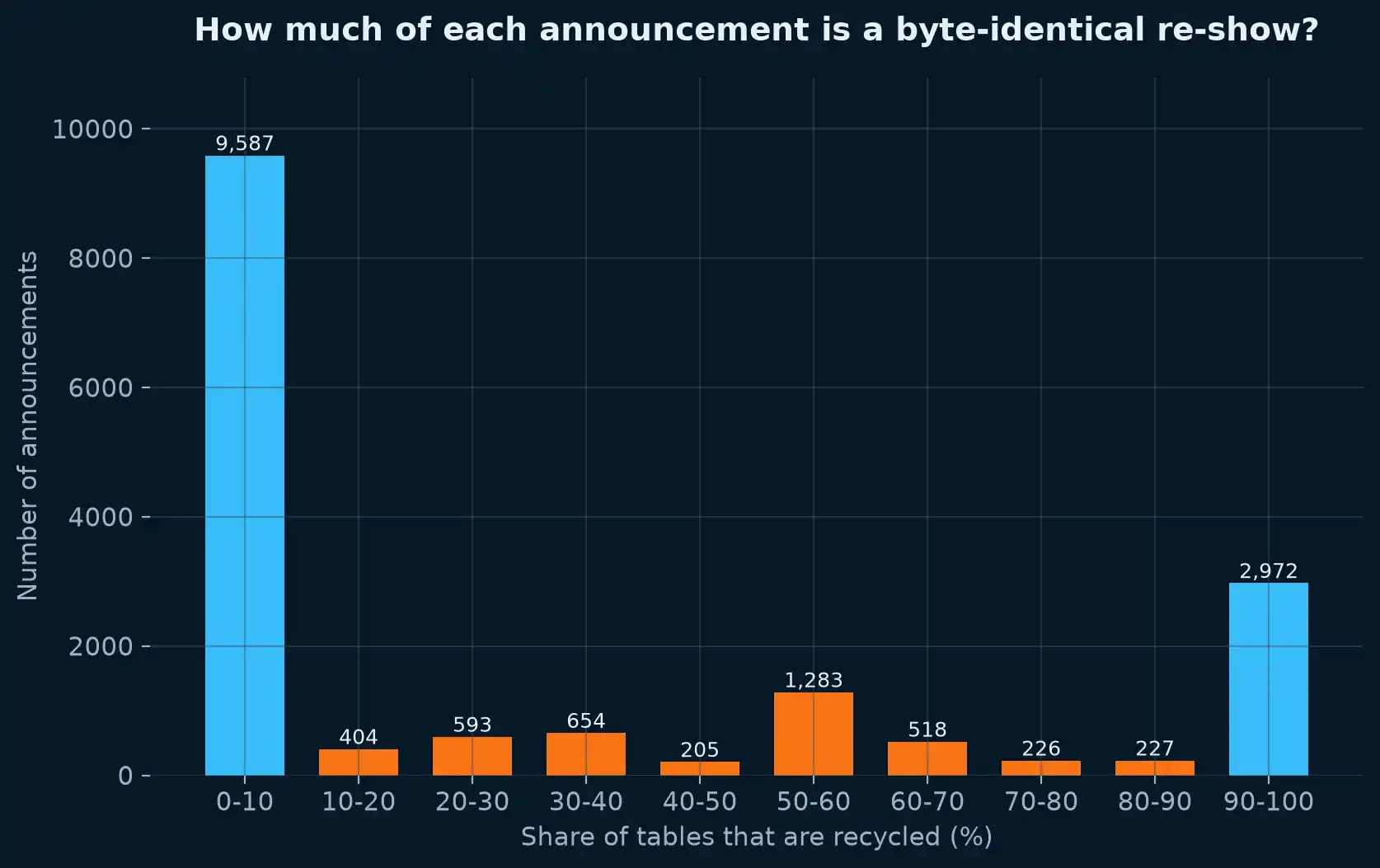
In 17.8% of announcements, at least 90% of the extracted tables had already appeared in an earlier announcement from the same company.
That does not mean those announcements contained nothing new. An announcement can contain new commentary, interpretations, corporate developments or other information outside its tables.
What it does show is that a substantial amount of the geological information carried through ASX announcements is not appearing for the first time.
And for anyone trying to understand the exploration history of a project, that distinction matters.
Key findings
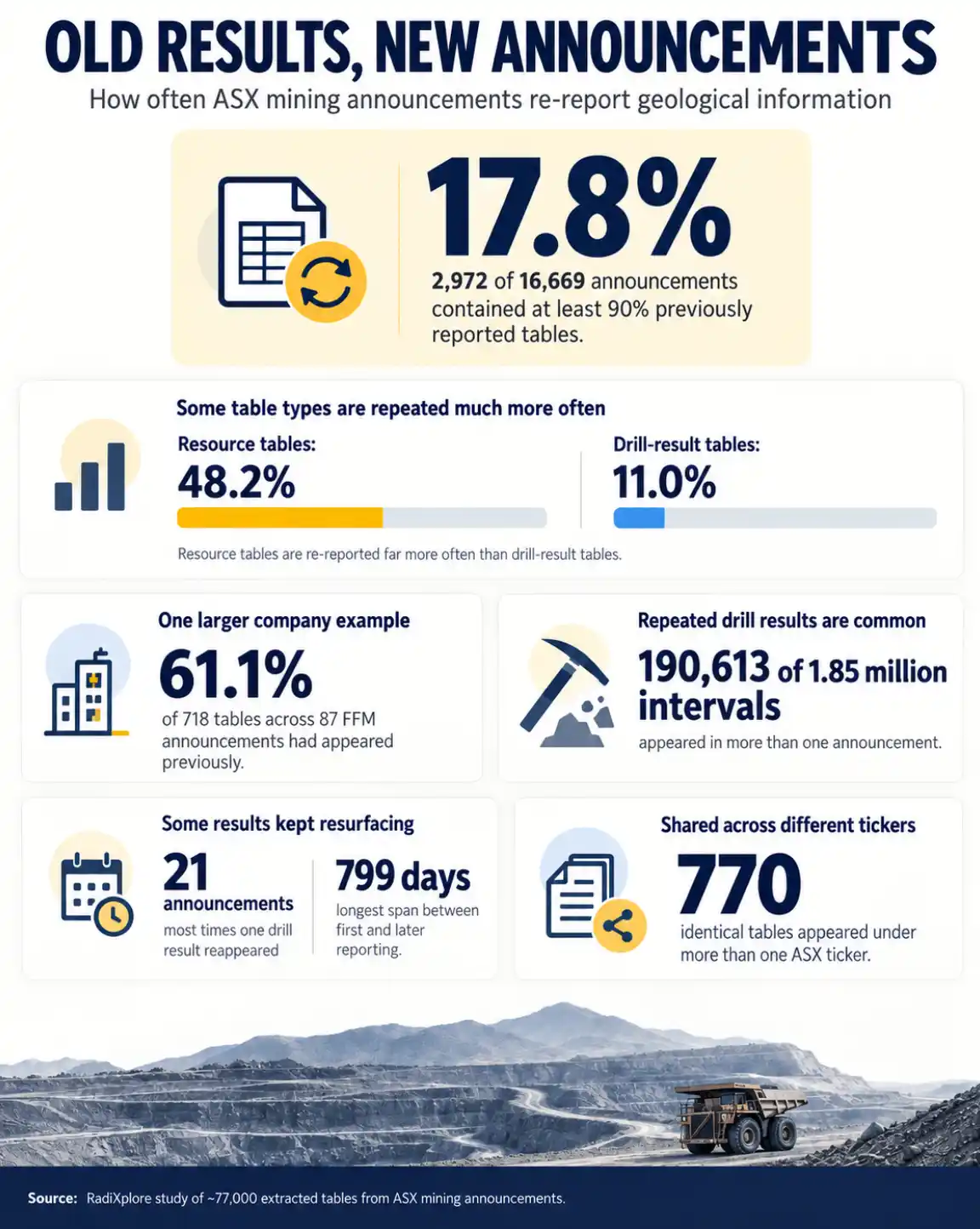
- 2,972 of 16,669 announcements, 17.8% contained at least 90% previously reported tables.
- Resource tables were re-reported far more often than drill-result tables: 48.2% versus 11.0%.
- In one larger example, 61.1% of 718 tables across 87 FFM announcements had appeared previously.
- Looking directly at drill results, 190,613 of 1.85 million intervals appeared in more than one announcement.
- Some individual drill results resurfaced repeatedly, with one appearing across 21 announcements and the longest observed span between first and later reporting reaching 799 days.
- We also found 770 identical tables appearing under more than one ASX ticker, suggesting another layer of shared or repeated information worth investigating.
Why does this matter?
Consider the normal life of a drill result.
A company drills a hole and reports an intersection to the market. That same result might then appear again in a quarterly activities report, an investor presentation, a project summary, a resource update or a later compilation of significant intersections.
There is nothing unusual or improper about this. In many cases, repeating earlier results is necessary to give investors context.
But from the perspective of someone trying to reconstruct the geological story of a project, those repeated mentions are not independent pieces of evidence.
A result reported ten times is still one result.
That sounds obvious when stated plainly. It becomes much less obvious when working across thousands of documents spanning years or decades.
If every occurrence is treated equally, the most frequently repeated result can begin to look like the most strongly supported result - even though all of those references may trace back to the same original observation.
That is why we became interested in measuring information novelty: not simply whether an announcement is new, but whether the geological evidence inside it is new.
How we measured it
We started with around 77,000 tables extracted from ASX mining announcements.
For each company, we compared its tables with tables that had appeared in its earlier announcements. If exactly the same table appeared again, we counted it as previously reported.
The important part is not the computer technique used to make that comparison. Conceptually, the question is simply:
Have we seen this table from this company before?
This first method is deliberately conservative.
If a company takes an old drill table and changes the formatting, rearranges the columns or retypes the values into a new table, it may no longer look identical even though the underlying geological information is the same.
So for drill results, we also ran a second comparison using the results themselves - the hole, interval and assay information.
That allowed us to identify cases where the same drill result appeared again even when the surrounding table had been reformatted.
The two approaches answer slightly different questions:
and
Has this same geological result appeared before?
Resource tables are repeated much more often than drill results
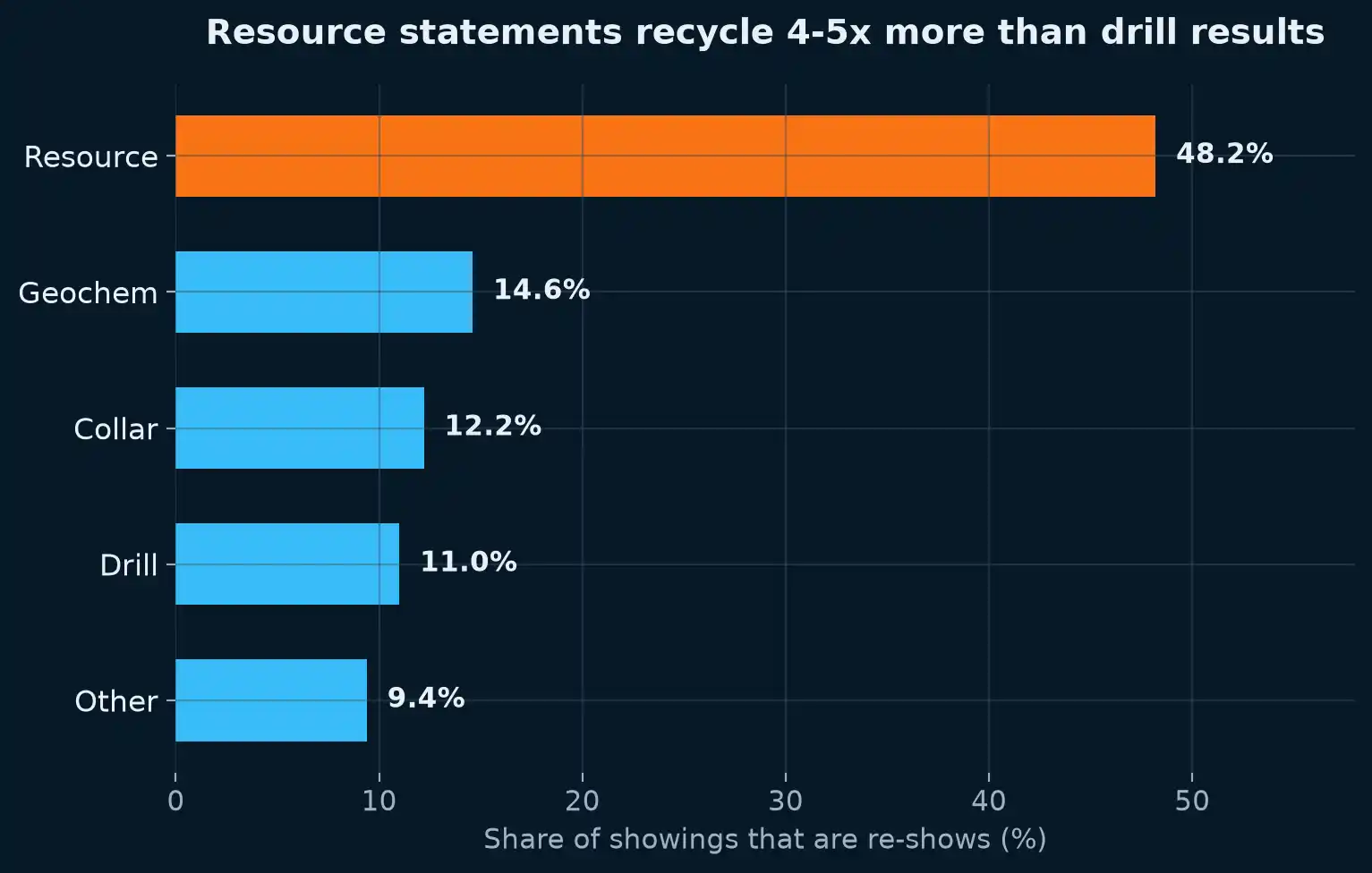
| Table type | Previously reported |
|---|---|
| Resource | 48.2% |
| Geochem | 14.6% |
| Collar | 12.2% |
| Drill | 11.0% |
| Other | 9.4% |
This was one of the most reassuring findings in the study because it is exactly what we would expect from the way exploration information is reported.
A Mineral Resource or Ore Reserve is a standing statement about a project. Once established, the same resource table may legitimately appear again and again in investor presentations, quarterly reports and subsequent project announcements until the estimate is updated.
A drill result is different.
An intersection is normally reported when the result becomes available. It may later be repeated for context, but the underlying observation itself does not change.
So finding that almost half of resource-table appearances were repeated, compared with only 11% of drill tables, makes geological sense.
It also illustrates why simply counting how often something appears in the record can be misleading.
A resource estimate mentioned twenty times has not become twenty separate resource estimates.
Some companies naturally carry more historical information forward
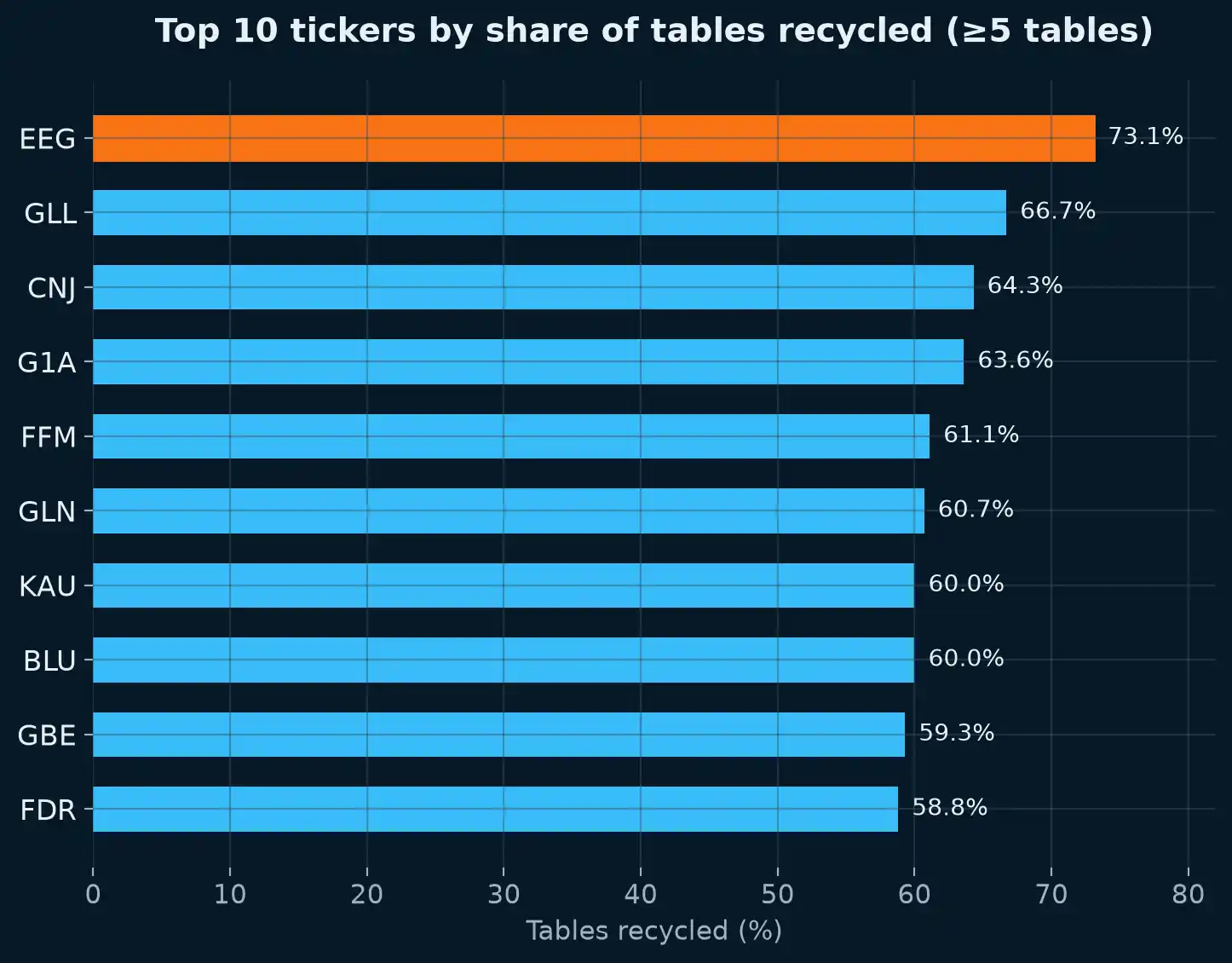
There was considerable variation between companies.
Among the companies with the highest levels of repeated table content in the current dataset were:
| Ticker | Announcements | Tables | Previously reported | Longest span |
|---|---|---|---|---|
| EEG | 6 | 26 | 73.1% | 260 days |
| GLL | 11 | 18 | 66.7% | 103 days |
| CNJ | 4 | 14 | 64.3% | 273 days |
| G1A | 8 | 11 | 63.6% | 232 days |
| FFM | 87 | 718 | 61.1% | 594 days |
| GLN | 37 | 112 | 60.7% | 665 days |
| KAU | 40 | 110 | 60.0% | 278 days |
| BLU | 4 | 5 | 60.0% | 454 days |
| GBE | 48 | 140 | 59.3% | 703 days |
| FDR | 22 | 51 | 58.8% | 379 days |
This should not be read as a ranking of companies behaving badly.
There are many legitimate reasons why one company may carry more historical material forward than another, including the type of project, the maturity of its resource base and the kinds of announcements it publishes.
The smaller examples also need to be treated carefully because a handful of tables can move the percentage substantially.
FFM is more interesting because of the scale of the sample.
Across 87 announcements containing 718 extracted tables, 61.1% of those tables had already appeared earlier in the company's record, with some recurring across a period of 594 days.
For someone reviewing those 87 announcements, the practical question becomes important:
How much new geological evidence was actually being added over time, and how much was existing evidence being carried forward for context?
Looking at the drill results themselves reveals more
Table matching can only take us so far.
A company can report the same drill result in two differently formatted tables. Visually they may look different, but geologically they describe the same observation.
So we also compared individual drill results using their hole, interval and assay information.
Across approximately 1.85 million drill intervals, we found 190,613 that appeared in more than one announcement.
Some appeared many times.
One individual result was identified across 21 separate announcements.
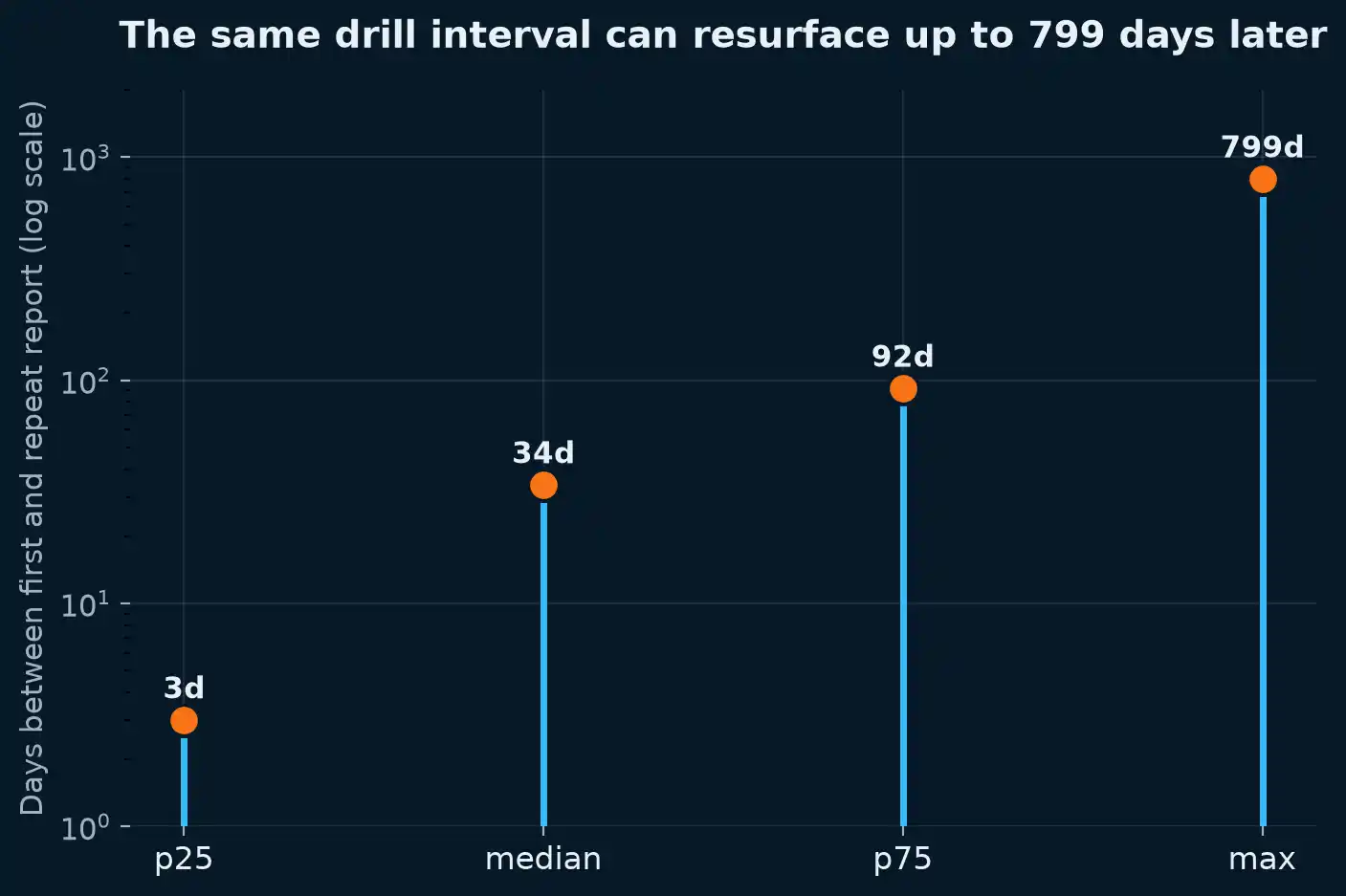
For drill results that appeared more than once, the time between the first appearance and a later appearance looked like this:
| Measure | Time |
|---|---|
| 25th percentile | 3 days |
| Median | 34 days |
| 75th percentile | 92 days |
| Longest observed span | 799 days |
A result resurfacing after three days is probably unsurprising.
A result resurfacing more than two years later is much more interesting.
To someone reading that later announcement without tracing the project's full disclosure history, the result can easily feel like part of the new information being presented.
But geologically, nothing new has been observed.
It is an older piece of evidence being brought back into the current story.
This led us to the next question:
For any given announcement, how much of the drilling information is actually appearing for the first time?
That is the question we explore in Part 2.
The same tables sometimes appear under different companies
We also found another curious pattern.
770 identical tables appeared under more than one ASX ticker, representing 3,159 appearances in the extracted dataset.
This is different from a company repeating its own earlier results.
We have not investigated every example individually, but there are several likely explanations.
Joint-venture partners may both reproduce the same drilling table in their respective announcements. Standardised or boilerplate tables may contain genuinely identical information across unrelated companies. Ticker changes and relistings can also make the same company's historical information appear under different codes.
For now, we have kept these cases separate from the company-level analysis because they represent a different problem.
But they raise an interesting future question in their own right:
How often does geological information move not only through time, but between companies?
A few important limitations
This is an exploratory study, and there are several reasons to interpret the numbers conservatively.
First, our table comparison will miss some re-reporting.
If an old table is reformatted or rebuilt, it may appear new to the table-level comparison. The drill-result comparison helps recover some of these cases, but only for drilling information that can be matched reliably.
Second, this current dataset does not yet cover the entire ASX mining universe.
Third, table categories are approximate.
Automated systems were used to distinguish drill, resource, geochemistry, collar and other tables. Those classifications are useful for seeing broad patterns, but they should not be treated as manually verified geological labels for every individual table.
And most importantly:
A previously reported table does not mean the announcement itself contains nothing new.
Our analysis measures the novelty of the tabulated geological information, not every statement or development contained within an ASX release.
Why we care about this at RadiXplore
This small experiment points to a much larger issue in geological intelligence.
Finding a piece of information is only part of the problem.
You also need to know:
Where did it originate?
Has it appeared before?
Is this a genuinely new observation, or another reference to an older one?
Have several apparently separate claims all come from the same original source?
Those questions become increasingly important when working across decades of exploration history.
A drill intersection may be repeated in a dozen later reports. A resource estimate may be carried forward for years. A historical interpretation can be quoted repeatedly until its original source is difficult to see.
If those repetitions are treated as independent evidence, they can distort how strongly the geological record appears to support an idea.
At RadiXplore, this is why we see provenance and evidence lineage as being just as important as finding the information itself.
The aim is not simply to answer:
"Where is this result mentioned?"
It is to understand:
"Where did this result come from, and is this actually new evidence?"
Does the market notice?
Once we could distinguish between newly reported drill results and results that had appeared before, there was an obvious next question.
Does the market react differently when an announcement contains genuinely new geological information?
In Part 2, we join these measures with ASX share-price and trading data to find out.