
Make decades of internal mining knowledge usable again.
Historical project files, reports, maps, drilling records and interpretations often sit across multiple teams and systems. RadiXplore helps organisations turn approved proprietary mining information into a connected intelligence environment that people and authorised AI agents can search and investigate.
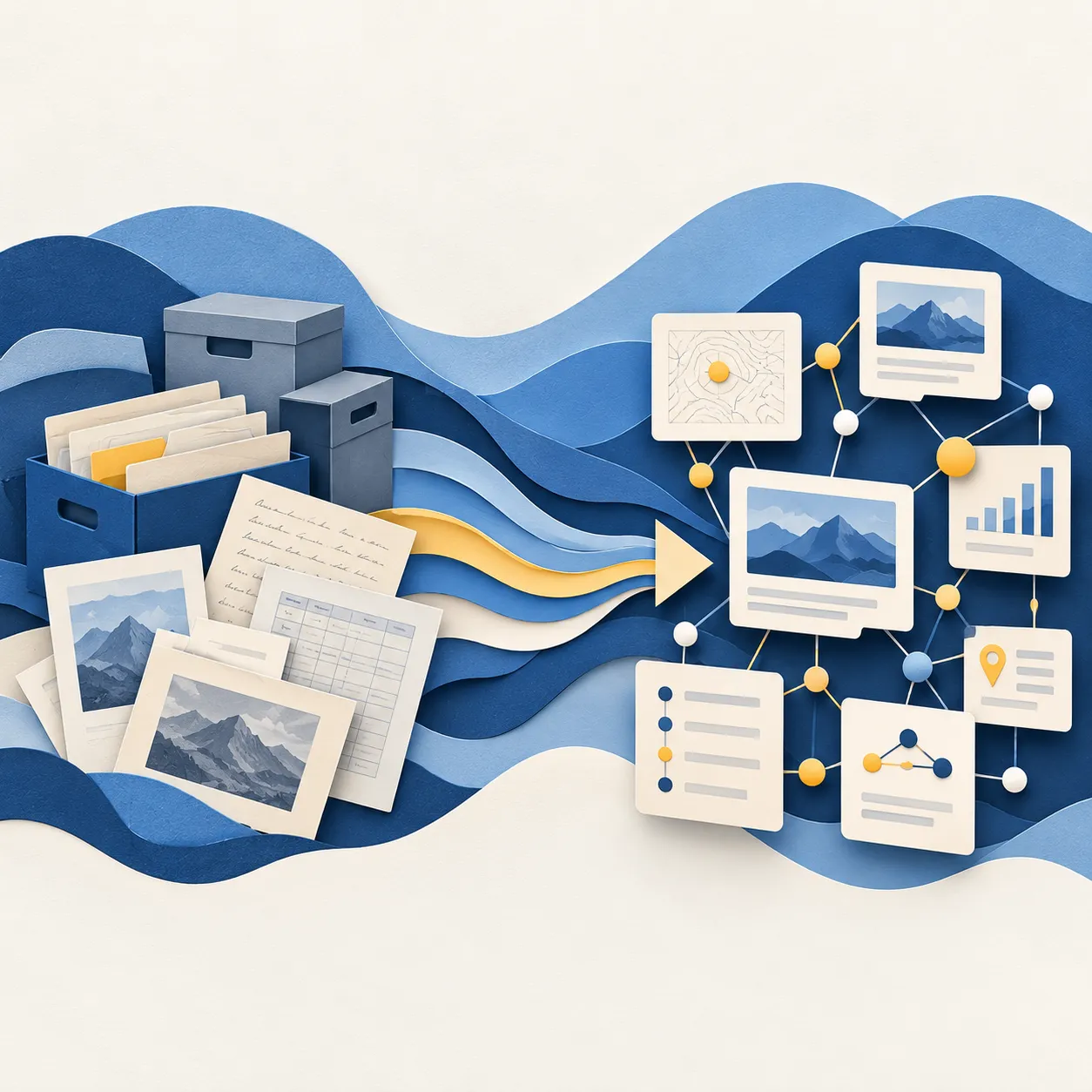
The archive isn't the same as the knowledge
A mining organisation can own decades of exploration records and still struggle to find the right information when it matters. Data may be scattered across acquired projects, inherited systems, legacy formats, personal drives and internal repositories.
Simply making files searchable can improve access. Reconstructing relationships among exploration activities, results, interpretations and locations can make those records much more useful.
From proprietary records to institutional intelligence
RadiXplore's enterprise approach can be scoped to:

Assess the archive.
Understand which files, systems, datasets and source collections are in scope.

Recover and structure evidence.
Process approved records, scanned documents and selected technical data as required by the engagement.

Connect the history.
Link relevant evidence by location, chronology, exploration activity, project, source and interpretation.

Enable investigation.
Provide an agreed environment and workflows for human users and authorised AI systems.
Maintain governance.
Define permissions, data-use boundaries, updates and ongoing responsibilities in the engagement.
Human and authorised AI access
A connected mining evidence environment can help geologists find historical work, inspect sources and investigate technical questions. Where contracted and technically supported, authorised AI agents can use the approved evidence model to retrieve sources and investigate relationships within governed analytical workflows and agreed permissions.
The purpose is not autonomous geological decision-making. It is to make institutional knowledge more usable and more durable.
Suitable applications
Inherited geological and exploration archives following acquisition.
Multi-project evidence and knowledge management.
Large internal historical reporting and technical data collections.
Organisation-wide geological investigation workflows.
Geological survey and national-scale archive transformation, where scoped.
Selected integration with external geological sources where permitted.
Ownership, security and data use
Proprietary information is handled according to the agreed contract, data rights, deployment and security arrangements. Customer source-data ownership, rights to agreed outputs, retention, access, third-party processing and any proposed reuse must be expressly documented.
RadiXplore does not assume rights to reuse or commercialise a customer's proprietary archive simply because it is ingested for an engagement.
Detailed deployment architecture, security controls and integrations are established as part of enterprise scoping.
Turn your archive into a usable intelligence resource.
Tell us what you hold, where the information sits and which decisions or workflows you need to support.