
Search historical geological reports for mineral exploration.
RadiXplore helps geologists and exploration teams find and investigate historical exploration reports and their underlying evidence across supported jurisdictions. Search within an area, trace reports and observations back to original sources, and use geological context to understand what previous explorers actually did.
What can you search?
Go beyond report titles and metadata.
Historical exploration knowledge often sits inside lengthy PDFs, scanned reports, handwritten documents, appendices, drilling records, maps and tables. A title or keyword search can miss relevant work when explorers used different terminology or methods.
RadiXplore brings together searchable historical records and mining-specific evidence so you can investigate the exploration record in context.
By location
Start from a region, project or area of interest and find associated historical exploration information.
By geological concept
Investigate geological ideas and observations without relying solely on identical wording in source documents.
By geospatial concept heatmap
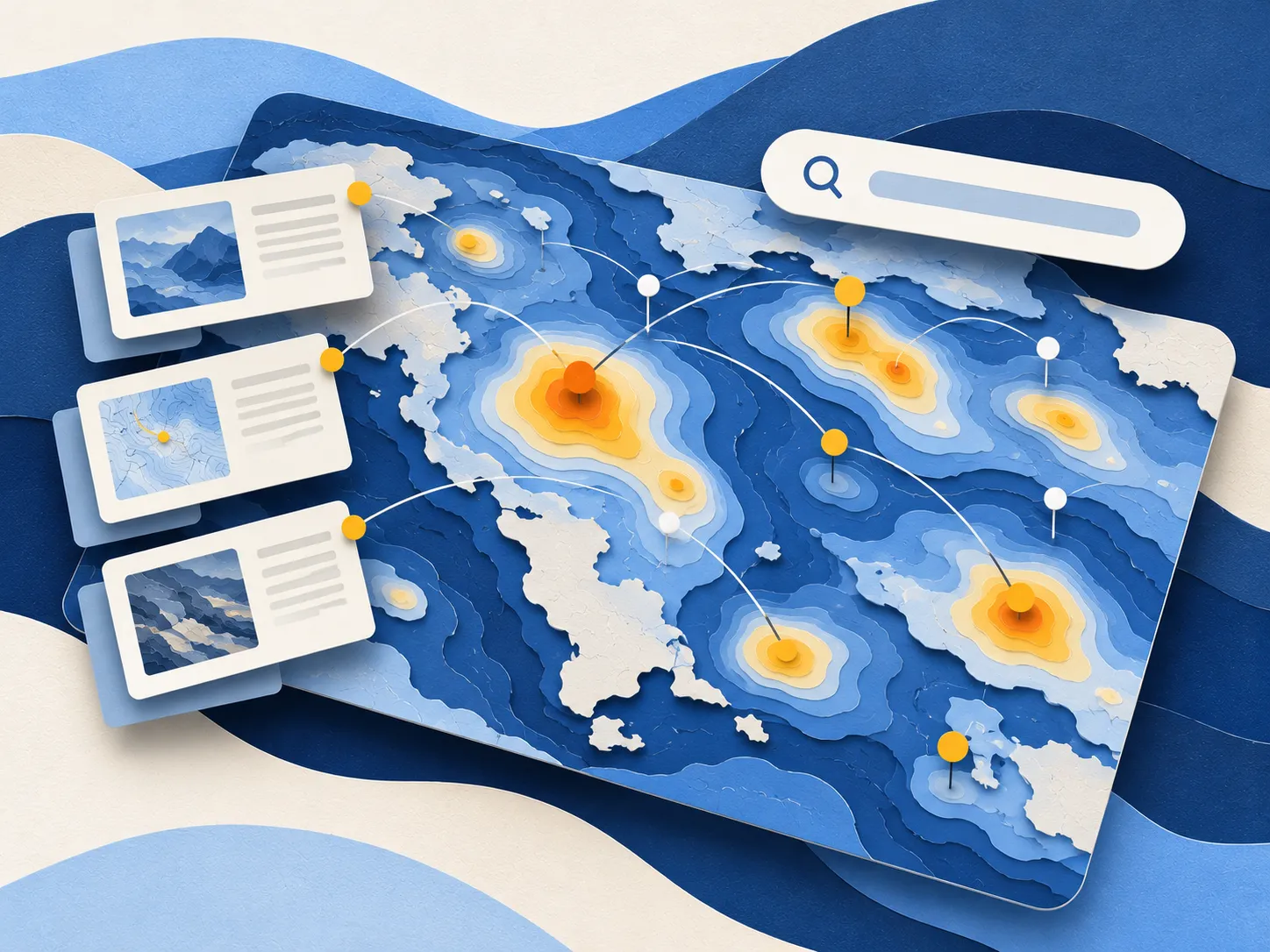
Map the geographical distribution of evidence matching a geological concept or search query, then investigate the underlying reports and records for the mapped results.
By report or exploration activity
Follow past programmes and inspect what was documented, tested, reported or recommended.
By technical evidence
Examine drilling, assay, geochemical, spatial and other structured data where available and validated for the jurisdiction.
By visual evidence
Locate maps, figures and tables associated with the report archive where they have been processed.
Turn a geological concept into a spatial investigation
Search the concept. See where the evidence appears.
Historical geological reports can refer to related observations in different places and under different terminology. RadiXplore's geospatial search heatmap lets users visualise where evidence matching a searched geological concept is represented geographically. Use it to investigate areas of interest and move from a mapped result back to the supporting report or available evidence.

Original sources remain important.
RadiXplore does not replace geological survey archives. Those archives are the original source repositories. RadiXplore adds a mining-specific search, evidence-connection and investigation layer over the supported sources.
When a finding matters, you need to inspect where it came from. RadiXplore is designed to keep important observations and inferences connected to source reports and underlying evidence wherever available.
Search across supported jurisdictions.
A project may sit within one jurisdiction, but the geological research often spans several collections. RadiXplore provides a single starting point for supported historical archives and data types.
Coverage is not identical everywhere. Some collections are searchable in the platform; others may be processed, enriched or available through a scoped engagement.
From a report to the exploration story
Finding a report can answer a question about one programme. Understanding the broader exploration history requires more.
RadiXplore connects the historical work across time, location, operator and geological interpretation. Its Mining World Model supports investigation of what was observed, why work was conducted where the records establish that rationale, what was tested, what changed and what remained unresolved.
This provides a path from finding the evidence to understanding the evidence and finally to deciding what deserves further geological evaluation.
Who uses this?
Geologists
Examining historical evidence, ideas and source documents.
Exploration managers
Reviewing areas and deciding which historical work needs closer attention.
Project generators
Screening unfamiliar ground and comparing exploration records.
Technical due diligence teams
Evaluating inherited project histories.
Corporate and enterprise teams
Needing a search-and-investigation layer across approved public or proprietary data.
Frequently asked questions
Search the exploration record with more context.
Tell us the region or geological question you are investigating. We'll help confirm the relevant data coverage and the best way to access RadiXplore.